
Chapter
Chapter 02: Our Exponential Challenge
2.1VISION 2030: AN EXPONENTIAL IMPERATIVE
The 2030 Strategy places children at the heart of South Africa’s early learning agenda, guided by four urgent and interconnected priorities:
Expanding Access: Reach an additional 250,000 children between 2025 and 2027, then 950,000 more between 2027 and 2030, bringing 1.2 million more children into quality early learning by 2030.
Raising Quality: Improve developmental outcomes by increasing the percentage of children classified as green (on track) on the Thrive by Five Index from 46% in 2024, to 48% by 2027 and 51% by 2030. At the same time, reduce those in the red category (falling far behind) from 28% in 2024, to 24% by 2027 and 19% by 2030.
Resourcing the Sector: Mobilise financial and non-financial resources from public, private, philanthropic and corporate partners to support this targeted scale-up.
Enabling Government Systems: Build transparent, responsive and integrated government systems as the backbone of early learning support networks focused on modernising core business processes, improving management information systems and digitising key functions across Provincial Education Departments (PEDs) and local government.
The response must match this challenge with an exponential approach. Incremental change is not enough. We need a system-wide transformation that scales quality and inclusion as fast as children need it.
2.2SHIFTING TO AN EXPONENTIAL MINDSET
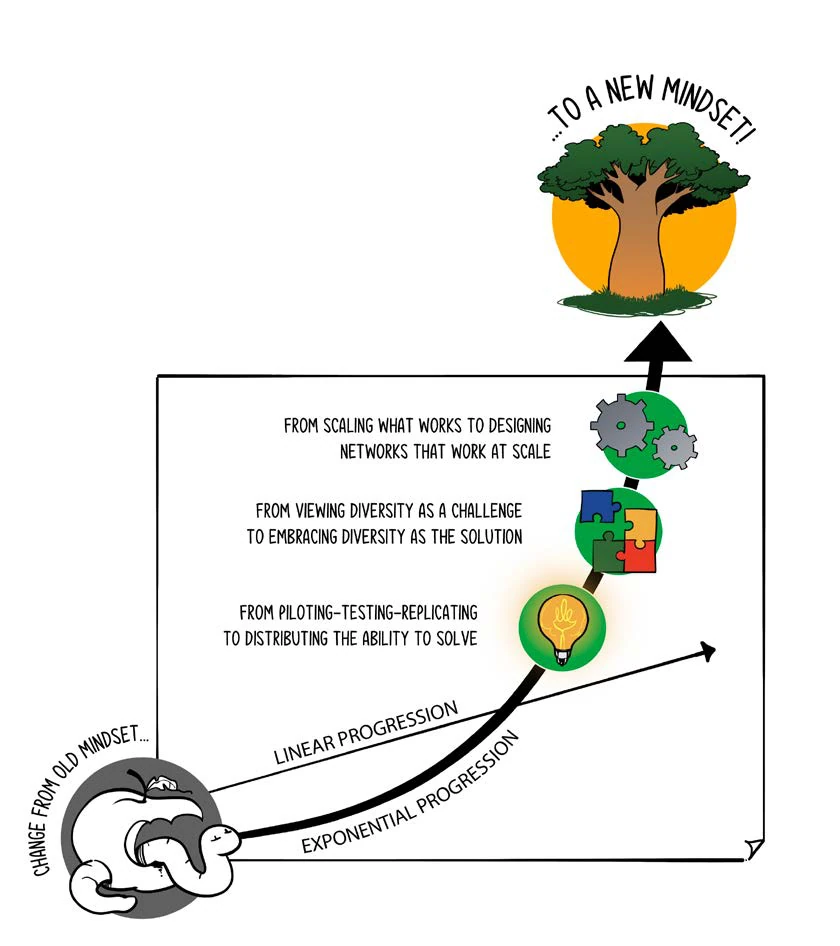
Reaching all children who need early learning, especially those historically excluded, will take more than expanding what already exists. It requires a new way of thinking across the ecosystem. We cannot depend on isolated projects or fragmented pilot initiatives. Growing slowly from one to ten to twenty programmes limits our ability to meet the large-scale need. The challenge is too big to solve alone, and too urgent to delay. We must create conditions where many actors solve problems together, enabling thousands to co-design and adapt solutions collaboratively.
This is the foundation of the exponential mindset: a fundamental shift from cultivating isolated excellence to building an interconnected ecosystem where everyone’s efforts multiply each other’s impact. Rather than asking “How can I solve this alone?”, we must ask: “If I cannot solve this challenge for everyone by myself, how can I create the conditions for many to solve together?”
To put this mindset into practice requires three key shifts, supported by shared actions: amplifying network effects by strengthening connections between government, civil society and markets; unlocking innovation through co-creation that enables locally rooted solutions; and investing in shared support systems, essentially the public goods like the shared narrative, policy frameworks, digital platforms and funding mechanisms that empower actors across the whole system to succeed together.
The three key shifts are:
- From scaling what works To designing networks that work at scale
What works may not scale, and what scales may not work in every context. Pilots often succeed in specific settings but stumble when conditions shift. We must design for scale from the outset, by building adaptive networks that deliver across diverse contexts. - From viewing diversity as a challenge To embracing diversity as the solution
No single solution can solve a complex, context-dependent problem. Instead of striving for uniformity, we must foster a thriving and unified ecosystem where multiple effective solutions co-exist, adapt and respond to local needs. - From piloting–testing–replicating To distributing the ability to solve
Proven solutions don’t always travel well. Real transformation comes from enabling those closest to children to lead problem-solving. This means investing in shared systems that support thousands of local actors to design, adapt and deliver.
2.3AMPLIFYING NETWORK EFFECTS
The early learning system is, at its core, a network. Like all networks, its value increases as connections grow stronger and more purposeful. When key actors exchange value, what they give and receive from one another, momentum builds. The result is network effects, collective impact that becomes greater than the sum of its individual parts. These effects are not just helpful, they are essential to achieving exponential change by 2030.
Reaching every child, across all geographies, income levels and social contexts will require activating the full ecosystem, from government at all levels, ELP providers and families, to NGOs, funders, community organisations and technical partners and researchers.
When these actors are connected and coordinated, the ecosystem becomes more responsive to local needs, supports context-appropriate solutions, enables peer learning, reduces risk and accelerates both innovation and reach. A dynamic, networked system doesn’t just work better, it works faster, fairer and at scale.
2.4UNLOCKING INNOVATION THROUGH CO-CREATION
Not every actor currently has the clarity, capability or capacity to contribute fully, or collaborate effectively. But innovation cannot depend on a few centralised sources. It must come from everywhere. To unlock this potential, the ecosystem needs to remove barriers and create environments where diverse innovations can emerge and thrive.
South Africa’s diversity means children grow up in very different settings, shaped by different histories, resources and social norms. Standardised, top-down models have often failed to bring lasting, relevant change. Solutions co-created locally with families, providers and communities are more relevant and sustainable.
Core principles for co-created innovation include:
- Viewing children as active participants, not passive recipients.
- Positioning families as engaged partners in learning.
- Empowering ELP providers to design contextual solutions.
- Using technology to support, not replace, human relationships.
- Embedding diversity as a strength, not a problem.
Every actor must become a problem-solver, spreading the ability to innovate across the system. Small wins ripple outwards, creating exponential impact needed to reach every child.
2.5INVESTING IN SHARED SUPPORT SYSTEMS
To support widespread collaboration and innovation, the ecosystem must lower the costs and complexity of change. Shared support systems provide this foundation.
Just as airlines share airports and websites share the internet, the early learning system needs shared platforms for service delivery, data, learning and funding. When done well, shared support systems enable a mixed model where government, NGOs, private providers and communities contribute according to their strengths, coordinated under a common vision.
The benefits are clear: reduced duplication and costs, improved quality and consistency across settings, and stronger collaboration and knowledge-sharing overall. Shared support systems allow scale while preserving diversity, quality and local responsiveness.
The Blueprint identifies five essential types of shared support systems:
- Physical support: Facilities, community spaces and early learning centres.
- Digital support: Platforms like eCares, data dashboards and coordination tools.
- Talent development: Training pathways, mentorship and ELP provider networks.
- Funding mechanisms: Blended finance models, pooled funding and subsidy mechanisms.
- Policy and legislative frameworks: Regulations and guidelines enabling quality services.
Many assets already exist, such as the Thrive by Five Index, Bana Pele Mass Registration Drive, eCares and the Early Learning Outcomes Measure (ELOM). Others still need to be developed or scaled. Effective use of these support systems require strong orchestration. This means financial, operational and strategic coordination that aligns actors, tracks progress and adapts to evolving needs. Open digital protocols and AI-enabled tools can enhance these systems by making it more agile, integrated, interoperable and inclusive.

2.6AT THE CORE: THOSE CLOSEST TO THE CHILD
True change starts with families and ELPs, the people children interact and engage with everyday. They have the greatest influence on children’s development and are the focus of this Blueprint.
Expanding access to quality early learning means supporting the existing network of over 200,000 trusted and resourceful ELP providers, primarily Black women micro-entrepreneurs. This makes investing in ECD a powerful lever for gender equity by creating livelihoods for women in underserved communities and lowering barriers to formal employment.
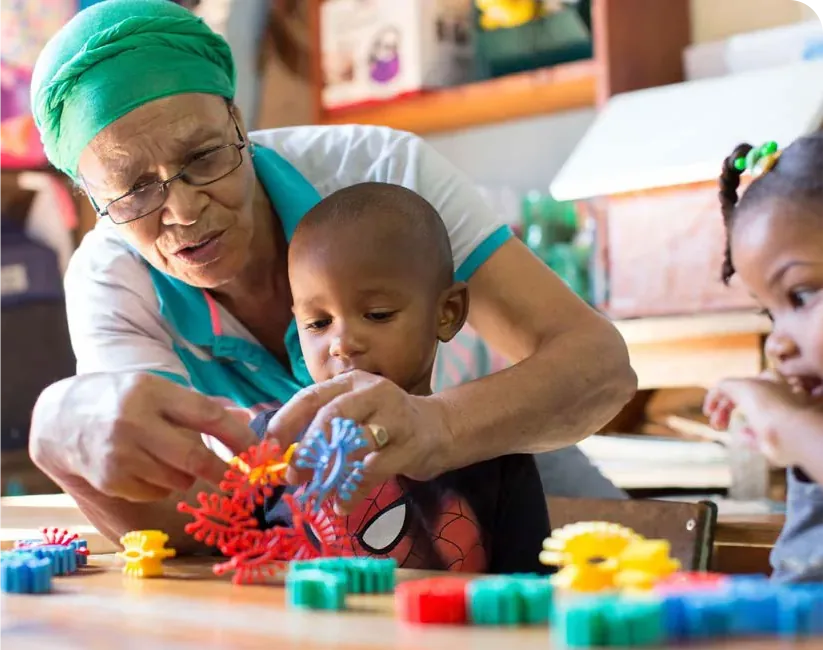
Children learn important and foundational capabilities from families in the home. Language, particularly their mother-tongue, is a powerful example of this, learning not through formal teaching but through the natural rhythms of daily care, conversation and love. This learning is irreplaceable and continues throughout a child’s life. ELP providers do not replace this vital role. Instead, they work as partners with families, complementing what happens at home by offering group-based learning, nutrition and care. Affordable early learning also enables parents to enter or remain in the workforce, unlocking greater financial independence and inclusion while knowing their children are thriving.
Achieving universal access by 2030 requires growing this network in size, quality and financial strength. This growth must happen rapidly and sustainably, underpinned by enabling support systems, innovation platforms and systemic reforms that improve quality, financial resilience and support sustainability.
To reach every child, we must move from fragmented short-term interventions to a connected ecosystem. This means investing in relationships, tools and shared support systems that allows diverse actors to learn from one another, amplify each other’s efforts and adapt to local needs.
The next chapter introduces the key actors in early learning and explores their unique roles in building a more coordinated, inclusive system.