
Chapter
Chapter 03: Coming Together for Impact
3.1BUILDING THE EARLY LEARNING ECOSYSTEM
Universal access to quality early learning by 2030 depends not just on individual actions but on how well the whole system works together. Progress hinges on the ability of diverse actors across government, civil society, communities and families to align their efforts, share responsibility and support each other toward a common goal.
At the heart of this ecosystem is the child. Children are reached through the people, programmes and places that shape their daily lives, starting with families at home and extending to ELPs and community spaces. Strengthening early learning means supporting those who directly care for children: families as first teachers and ELPs led by dedicated practitioners, caregivers and micro-entrepreneurs who complement and extend home-based learning.
This chapter introduces the key actors in the ecosystem, their unique roles and how coordinated action across sectors can build an ELP ecosystem that grows in reach, resilience and equity.
Understanding the early learning ecosystem requires systems thinking, an approach that recognises complexity and interconnectedness, mapping the feedback loops and interactions between different actors and initiatives. Rather than viewing each component in isolation, systems thinking helps us see how parts work together as a whole, revealing the interdependencies that drive change.
The Early Childhood Development Action Network (ECDAN), in partnership with Harvard University and South African ECD partners, has developed an ECCE Systems Map to support the scaling of interventions sustainably and equitably across the Global South. This map complements the Blueprint’s approach by illustrating how actors, assets and systems interact to enable transformation. Readers can explore the ECCE Systems Map at this link to gain deeper insight into how the ecosystem dynamics outlined in this chapter operate in practice.
3.2KEY ACTORS, ASSETS AND SYSTEMS
To turn ambition into action, the system must act as a coherent whole that encourages collaboration, embraces diversity and focuses on those closest to the child. This Blueprint prioritises empowering ELP providers while energising the broader ecosystem that supports them.
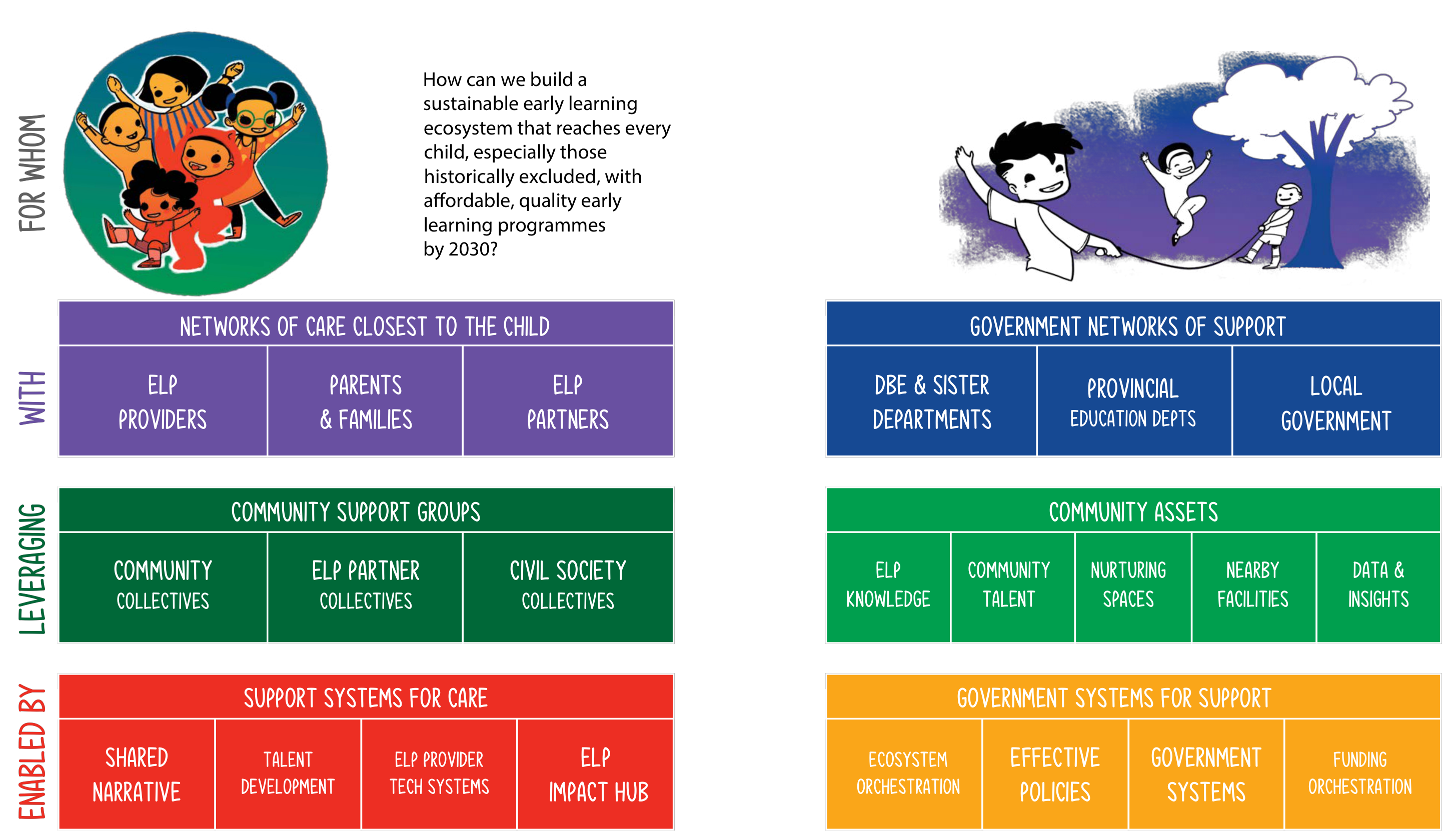
South Africa’s early learning ecosystem can be understood through four interconnected dimensions:
- Who we act for: Children, who need joyful, nurturing, safe and stimulating environments both at home and in ELPs to thrive by five.
- Who we act with: The Networks of Care Closest to the Child, which includes ELP providers, families (parents and caregivers) and ELP partners, as well as the Government Networks of Support comprising national, provincial and local officials who enable and resource frontline delivery.
- What we can leverage: Community Networks of Support including community organisations, ELP partners and civil society collectives, as well as Community Assets such as local knowledge, talent, physical spaces and data.
- What must enable the system: Robust Shared Resources for Care, which includes the shared narrative, talent development, digital platforms and innovation capacity; and Government Systems for Support, encompassing orchestration capabilities, policy frameworks and financing mechanisms.
This approach ensures all actors are identified and supported to act at scale while aligning diverse strengths toward one goal: improving early learning outcomes for all children, especially those most at risk.
Early learning delivery must operate as a dynamic system of change that learns from evidence, adapts to local realities and evolves through continuous feedback from ELP providers, families and communities. Flexibility and responsiveness are critical, always grounded in the shared mission that every child thrives by five.
While the DBE and its sister departments continue to play a central enabling role, the ecosystem’s effectiveness depends on keeping children’s needs first and empowering partners at all levels to lead confidently within their spheres. This requires convening multiple partners, supporting collaborative planning and implementation, and embedding learning and adaptation processes.
Throughout this Blueprint, we use specific terms to describe different groups of actors and systems, such as Networks of Care, Community Networks of Support and Government Systems for Support. These names are provided for clarity and consistency, but we recognise that actors within the ecosystem may identify themselves differently. As the shared narrative develops through listening and engagement, the language we use will continue to evolve to reflect how communities and practitioners choose to describe their own roles and relationships.
SUSTAINABLE EARLY LEARNING
3.3STRENGTHENING THE NETWORKS OF CARE
Transforming early learning requires deep collaboration among ELP providers, families, ELP partners and government at all levels. These relationships must be nurtured, resourced and actively supported to deliver quality early learning at scale.
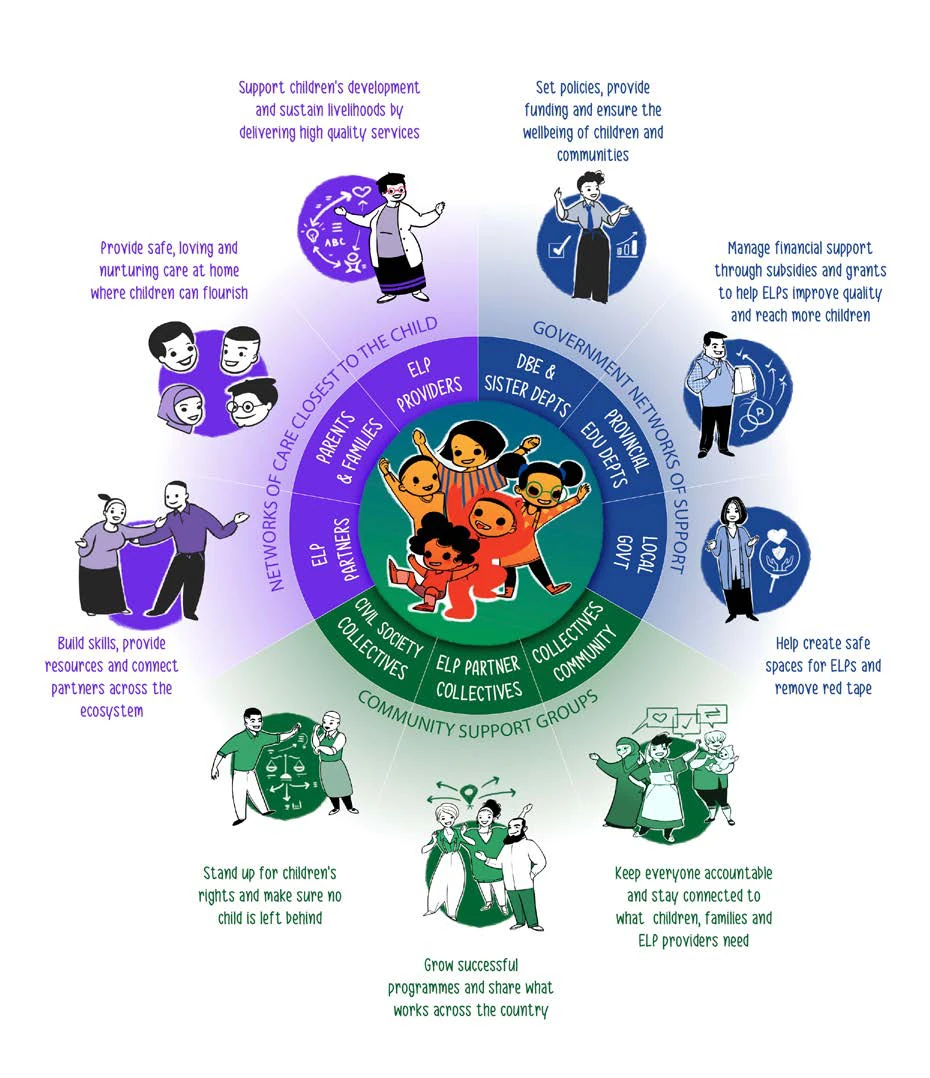
This Blueprint identifies three interconnected networks made up of nine primary actor groups who together form a network of networks driving the overall ecosystem.
3.3.1NETWORKS OF CARE CLOSEST TO THE CHILD
Closest to the child, these actors shape daily learning, caregiving and support.
- ELP Providers: Deliver early learning in centres, homes and community spaces. They are mostly women, and support children’s development, while sustaining livelihoods as micro-entrepreneurs who anchor the local care economy. Their programmes are trusted, contextually rooted and often serve as community hubs. Providers hold practical insights about what works, offering ground-level problem-solving and innovation that strengthens the wider system.
- Families: Create the foundation for learning through nurturing care at home. They provide love, cultural knowledge, daily observations of children’s needs and, where possible, financial contributions. Their trust in ELP providers, demonstrated through consistent enrolment and attendance, is essential to effective early learning partnerships. When families are included and respected, early learning becomes a shared effort rather than a service delivered to them.
- ELP Partners: NGOs, Resource and Training Organisations (RTOs), intermediaries and community groups that build capacity, provide tools and strengthen linkages across the ecosystem. They offer training, mentorship, learning materials, data systems, operational support, access to networks and advocacy. By translating frontline insights into broader sector learning, these partners help ELP providers grow quality and are critical in contributing to system-wide improvement.
3.3.2GOVERNMENT NETWORKS OF SUPPORT
These actors create the enabling conditions for frontline delivery.
- The DBE and its sister departments: Lead policy direction, public financing and accountability for child and community well-being. They provide institutional legitimacy through registration, financial support via subsidies and grants, regulatory frameworks that encourage growth, and tools and technology that strengthen quality. National government departments also play a key role in recognising and celebrating success, which builds trust in early learning services.
- Provincial Education Departments (PEDs): Administer policies, funding and support to ELPs. This includes, among many other areas, registering ELPs, managing subsidies and the ECD Maintenance Grant, overseeing compliance with programme, health and safety standards and coordinating district-level support. Provincial teams work closely with providers and partners to improve quality and expand access across communities.
- Local Government: Implement municipal regulatory processes for ELPs to meet health, safety and environmental standards. Local officials are a critical link between policy and practice, supporting the provision and planning of safe spaces for ELPs and helping remove regulatory barriers, especially in under-resourced communities.
3.3.3COMMUNITY SUPPORT GROUPS
These collaborative localised networks work toward shared goals, offer trusted and context-specific support.
- Community Collectives: Keep local communities accountable and stay connected to what children, families and ELP providers really need. They offer safe spaces, volunteers, local knowledge, cultural understanding and the ability to bring people together. When strong, these collectives make early learning a normal and valued part of everyday community life.
- ELP Partner Collectives: This includes a diverse range of organisations including delivery-focused NGOs, RTOs, academic and research institutions as well as networks and membership-based partnerships. Stronger collaboration amongst these partner organisations can enable innovation, establish evidence-based best practice, accelerate new quality access and share learning across regions.
- Civil Society Collectives: Advocate for children’s rights, equity and inclusion, helping close gaps for the most vulnerable. These coalitions bring deep sector expertise, community credibility and a commitment to social justice. They play a vital role in identifying barriers, enhancing accountability and co-creating solutions rooted in lived experience.
To embed resilience, the DBE and its partners must strengthen the relationships linking people, places and practice. This means supporting actors across all three networks of care to collaborate, adapt and grow the early learning movement together.
In a thriving ecosystem, no actor operates in isolation. Every participant plays a dual role, both contributing to and benefiting from a dynamic exchange of services, knowledge, resources and trust. These value flows form the living connective tissue of South Africa’s early learning landscape. When relationships are strong, they generate momentum. When they weaken or break, they signal friction as well as an opportunity for intentional action to rebuild trust, improve coordination and reinforce the foundation on which quality early learning depends.
3.4LEVERAGING ASSETS AND INFRASTRUCTURE
The successful delivery of the 2030 vision requires collaboration and iteration. South Africa’s early learning sector already has powerful assets and systems that can be mobilised immediately, alongside others that require further investment and strengthening. By building on what works, and reducing duplication, progress can accelerate at scale.
This Blueprint identifies three categories of shared assets, comprising 13 building blocks that together support a cohesive and responsive system. These resources are collective assets, open to and usable by all actors in the ecosystem.
3.4.1COMMUNITY ASSETS
These tangible assets exist in communities and programmes today and can be expanded, strengthened or adapted to reach more children with quality early learning.
- ELP Knowledge: Proven practices, insights and models that improve outcomes for children across diverse settings. This includes practitioners’ ground-level experience, locally relevant solutions and innovations that emerge from daily practice, and is essentially applied knowledge that strengthens the sector when shared widely.
- Community Talent: Local youth, elders and caregivers who can be activated to support access and quality. Communities hold deep reservoirs of volunteer capacity, entrepreneurial potential and cultural wisdom that enrich early learning when recognised and supported.
- Nurturing Spaces: Trusted community spaces that can be transformed into safe, accessible environments for learning, such as underused buildings, faith-based facilities, community halls or homes. With the right investment, these become welcoming places rooted in community identity and ownership.
- Nearby Facilities: Clinics, play areas and public spaces that integrate child health, development and play. When early learning connects with local health and community facilities, families gain more holistic and convenient support for their children’s wellbeing.
- Data and Insights: Open, trusted datasets and evaluation tools that guide evidence-informed decision-making. This includes feedback from practitioners and families, developmental assessments, community-level insights, administrative data and tools that enable responsive planning and continuous improvement.
3.4.2SUPPORT SYSTEMS FOR NETWORKS OF CARE
These systems strengthen day-to-day delivery by building the capability, confidence and collaboration of ELP providers. As micro-entrepreneurs, and often key community leaders, these women run small businesses that anchor early learning in local contexts. Support systems must therefore empower them to grow sustainable enterprises while delivering high-quality services for children.
- Shared Narrative: A unifying vision that places children at the centre and energises families, communities and practitioners around the value of early learning. Co-created with those closest to the child, this narrative shapes how early childhood development is understood, spoken about and prioritised.
- Talent Development: Pathways that attract, grow and retain local talent across the early learning workforce, including practitioners, assistants, coaches, field support and principals. They provide accessible training, mentorship, recognition and career progression that professionalise the sector while remaining open to community entry points.
- ELP Provider Technology Systems: Digital tools that streamline management, expand access to learning resources and connect practitioners to peers, coaches and administrative systems. These platforms help reduce isolation, strengthen practice and improve the flow of real-time information that supports responsive decision-making.
- ELP Impact Hub: A shared data and innovation space where practitioners and partners can develop, test and refine solutions rooted in local realities. The hub helps surface what works, accelerates learning across communities and enables promising approaches to be adapted and scaled.
3.4.3GOVERNMENT SYSTEMS FOR SUPPORT
These enabling conditions ensure alignment, coordination and long-term sustainability across the ecosystem.
- Ecosystem Orchestration: Mechanisms for accountable, multi-stakeholder coordination and delivery across all stages of the Blueprint. This includes leadership teams, regular convenings, shared communication channels and governance structures that help the sector work together effectively towards common outcomes.
- Effective Policies: Clear, coherent frameworks that enable inclusive, locally adaptable delivery. Policies must balance quality standards with flexibility, allowing diverse models to thrive while protecting children’s safety, wellbeing and developmental needs.
- Government Systems: Transparent, streamlined processes at national, provincial and local levels. These systems include registration, subsidy administration, quality assurance, data management and regulatory processes that enable ELPs to open, stabilise and grow.
- Funding Orchestration: Strategic alignment and coordination of public and private capital to enable sustained investment in early learning. This includes subsidy mechanisms, blended finance structures, infrastructure funds, livelihood support and organised philanthropic contributions that flow where they are most needed.
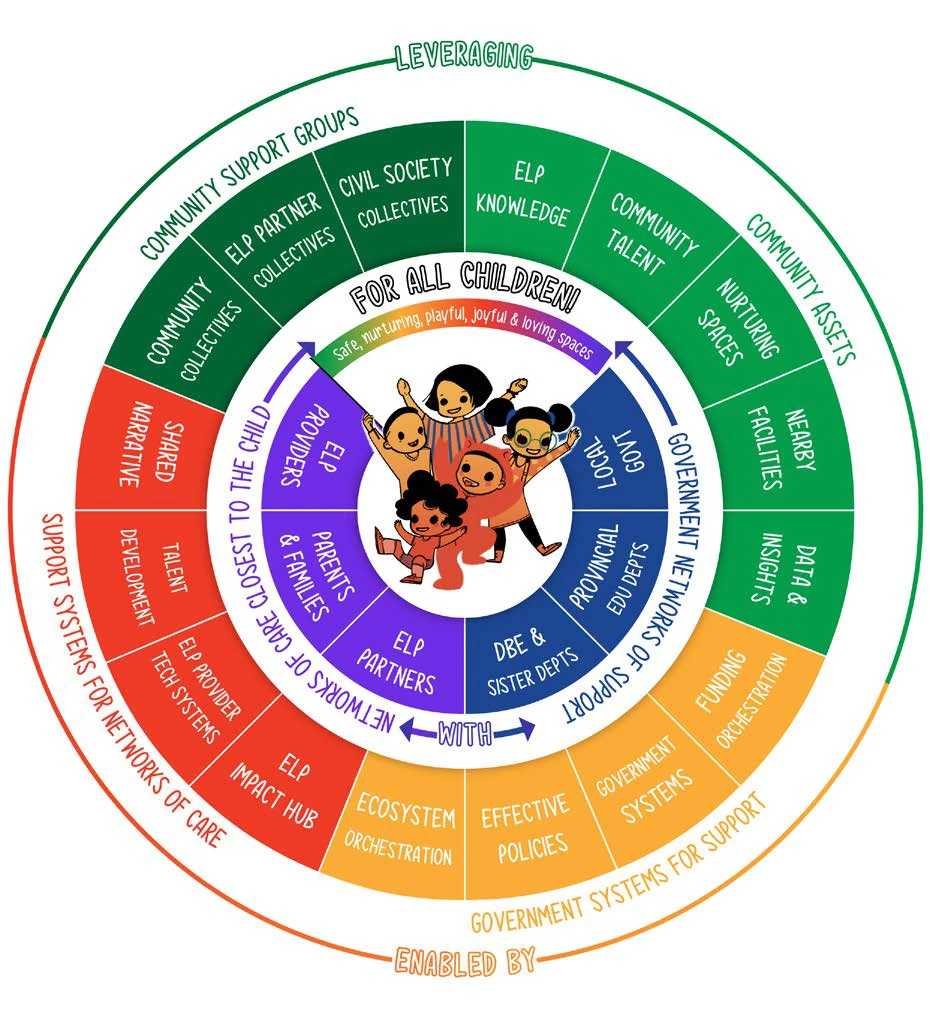
Together, these shared assets and support systems form a robust foundation for a coherent, responsive ecosystem. They reduce duplication, accelerate knowledge-sharing, amplify ground-up innovation and strengthen the sector’s ability to scale and adapt. Many of these building blocks already exist and are functioning well. The task ahead is to deepen the connections between them, close critical gaps and ensure they work together as an integrated whole.
The following chapter outlines the strategic pathway for implementation, organised into five interconnected and overlapping stages: Prime, Engage, Support, Sustain and Integrate. Together, these stages chart how South Africa can move from intention to action, guiding the country toward universal access to quality early learning by 2030.