
Chapter
Chapter 06: Shaping Our Shared Narrative of Care
6.1WHY SHARED NARRATIVE MATTERS
Early learning is often described through acronyms, technical terms and specialist language, much of which is essential for system leaders but unfamiliar to parents, families and communities. This creates distance from the very people whose participation is key to children’s success. We cannot scale impact if early learning feels inaccessible or exclusive.
Specialist terminology has its place, but scaling quality early learning requires a shared narrative that places children at the centre and resonates with the network of care closest to them. This shared narrative acts as the operating system for early learning: a unifying story that helps people understand what matters, why it matters and how they can contribute.
Although it may appear intangible, a shared narrative has powerful, practical functions such as:
- Unifying and strengthening the network of care closest to the child, drawing families and communities more meaningfully into early learning.
- Mobilising collective effort toward universal access, engaging a broader range of stakeholders and actors.
- Awakening belief in the full potential of every child and reinforcing the value of early learning in shaping lifelong outcomes.
In a nation still healing from deep-rooted inequalities, few symbols carry greater hope for transformation than a child. Yet young children, especially those from historically marginalised communities, often remain on the periphery of South Africa’s collective consciousness.
To truly transform the future, children must be placed at the centre of our national priorities. This is not only a moral imperative but a social and economic necessity. Lasting change requires more than policies and programmes, it calls for a shared belief, a collective sense of responsibility and a cultural awakening that recognises early learning as a public good and cornerstone of progress.
The goal is not merely to improve early learning outcomes, but to ignite a generational shift in how we see, value and invest in our youngest citizens.
6.2THE SHIFT WE ARE CALLING FOR
Today, early learning is too often viewed as babysitting, welfare or simply a stepping stone to formal education, rather than as a critical pillar of national development. This Blueprint calls for a bold shift in societal perspective:
- From passive to powerful: Children are not merely recipients of care. They are future innovators, leaders and changemakers.
- From care to catalyst: Early learning is not a welfare service. It is a powerful driver of economic growth, social equity and national resilience.
- From fragmented to foundational: ELPs are not temporary solutions but vital community institutions that inspire trust, attract investment and serve as a shared public mission.
- From sympathy to potential: ELP providers are not volunteers or charity workers. They are entrepreneurs, skilled professionals and nation-builders, nurturing the next generation.
Shifting public perception does not happen overnight. It requires storytelling that moves hearts, symbolism that captures imagination, repetition that builds recognition and celebration that inspires action. Not just a communications campaign, a movement.
6.3BUILDING THE SHARED NARRATIVE TOGETHER
This narrative cannot be imposed from above. It must be co-created through deep listening to families, ELP providers, communities and children themselves, uncovering the hopes, fears and beliefs that shape how people experience early learning every day.
The Blueprint proposes a collaborative process (detailed in Actions 9 & 10) that:
- Listens at scale through accessible tools and inclusive engagement, amplifying voices often excluded from national discourse.
- Discovers shared truths about what South Africans believe about children, childhood and our collective responsibility.
- Creates cultural resonance by working with artists, musicians and storytellers to translate insights into formats that feel authentic and familiar across South Africa’s diverse communities.
- Embeds the narrative everywhere including in clinics, schools, community events, media and everyday conversations, making early learning visible, valued and celebrated.
6.4EVERY VOICE MATTERS
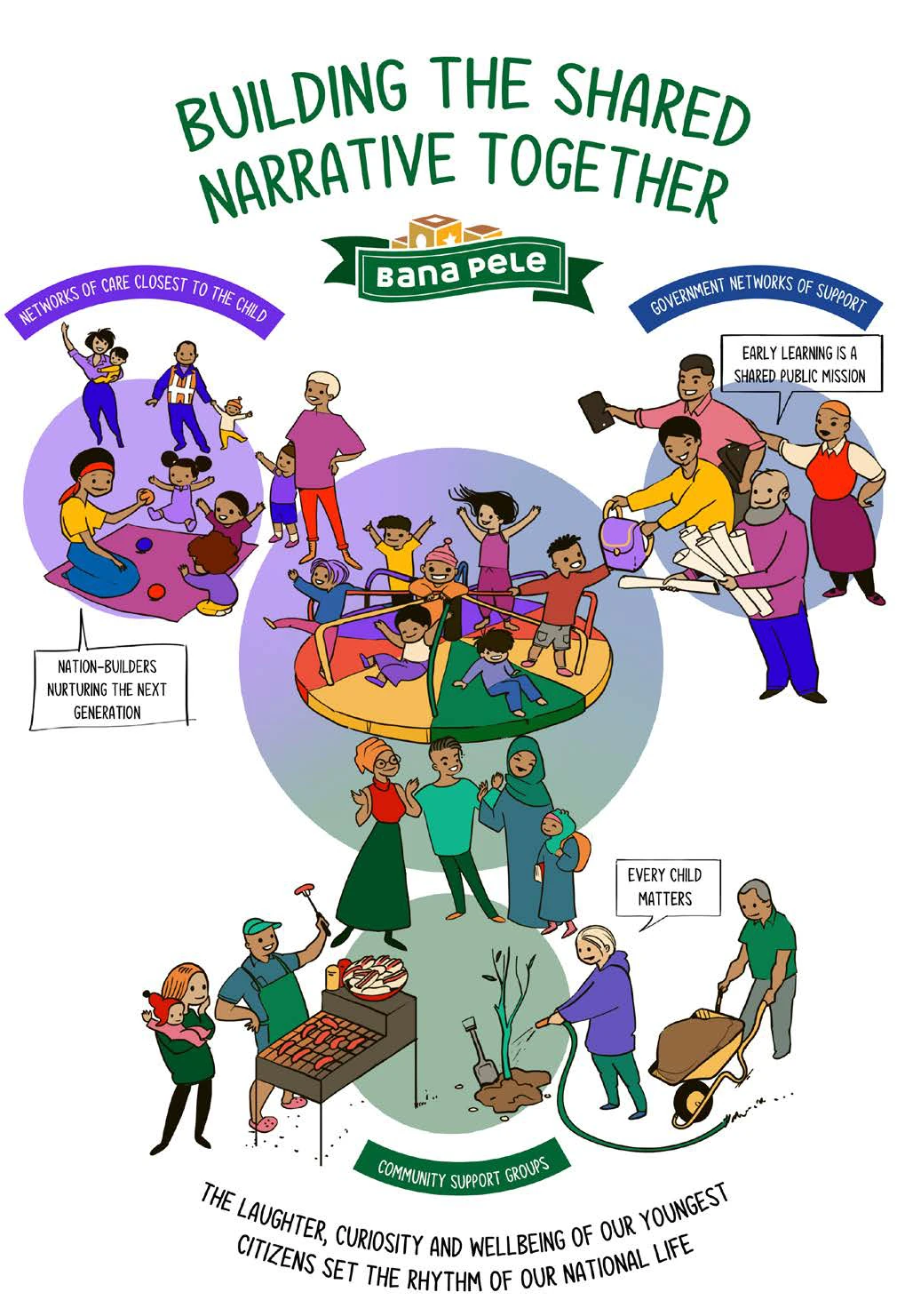
Bringing this narrative to life requires every actor in the ecosystem:
- Families share their stories and dreams for their children.
- ELP providers champion the narrative in their daily work with children and families.
- Communities integrate storytelling and celebration into local gatherings and events.
- Civil society facilitates listening spaces and amplifies grassroots voices.
- Creative talent translates the narrative into music, art and cultural expressions.
- Government leads coordination and embeds the narrative in policy and communication.
When a nation listens deeply to its children, and to those who raise and teach them, it cannot remain the same. Budgets shift. Policies shift. Public attitudes shift.
Achieving universal access to quality early learning requires more than commitments in policy, it calls for a society where every child matters in practice, in every home, community and institution. This Blueprint invites all South Africans to help build a society where the laughter, curiosity and wellbeing of our youngest citizens set the rhythm of our national life.
The next chapter turns to translating this shared narrative and growing movement into concrete, collective action, calling every ecosystem actor to step forward, now and together.