
Chapter
Chapter 05: Strengthening the Ecosystem
With the early learning sector primed and mobilised for coordinated action, the focus shifts to the people and programmes that bring it to life. Foundational elements introduced in Chapter 4, such as policy reforms, support systems, digital platforms and the shared narrative, are designed to empower key actors across the early learning landscape.
5.1REINFORCING THE ABILITY TO SOLVE
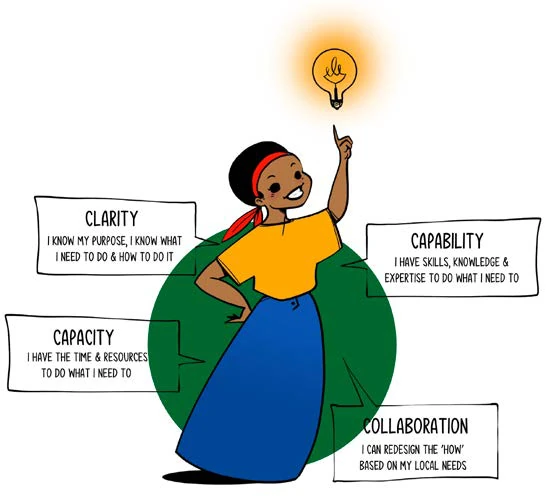
ELPs, families, NGOs, government officials, funders and others do not operate in isolation, they are part of an interconnected system. Strengthening their ability to solve problems within their own contexts, while encouraging them to listen, learn, adapt and improve together, is essential to achieving progress at scale, with speed and sustainability. Each actor’s effectiveness depends on their own ability (clarity, capability and capacity), as well as how well they collaborate.
The actions outlined across the five stages of Chapter 4 support and reinforce these abilities, creating a compounding effect that makes the whole system stronger.
5.2LISTENING TO EVOLVE TOGETHER
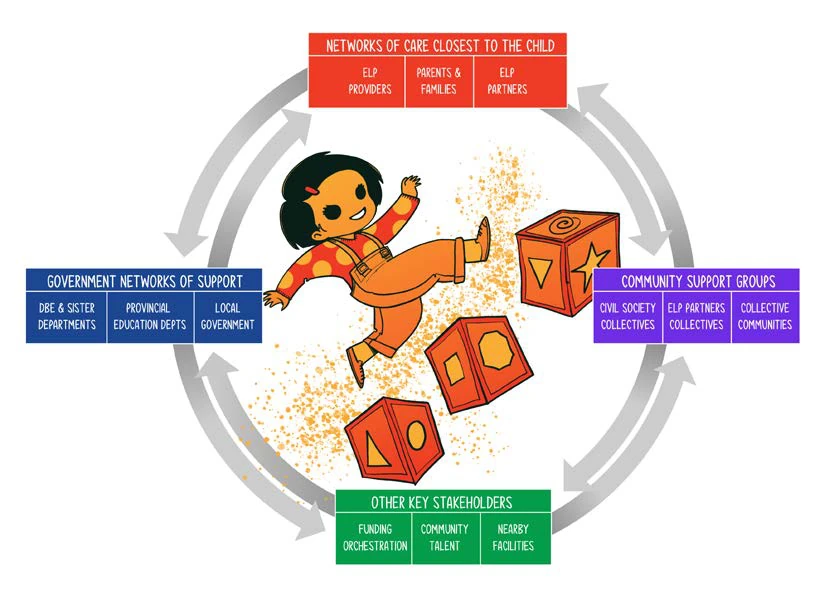
For a system to improve, honest and meaningful feedback must flow throughout, from homes and early learning centres, to NGOs, communities and government systems. As described in the Integrate stage, structured listening can strengthen key relationships and generate positive network effects, helping the system learn, adapt and improve.
THE VIRTUOUS LOOP: REINFORCING ABILITIES, LISTENING AND EVOLVING TOGETHER
5.3STRENGTHENING ACTORS ACROSS THE ECOSYSTEM
5.3.1EMPOWERING ELP PROVIDERS
ELP providers are the frontline for delivering children’s early learning and enabling their full developmental potential. While thousands already serve communities across South Africa, led mostly by women, many more are needed to achieve universal quality access by 2030.
Significant investment is already flowing into the sector to enhance provider capability, sustainability and reach. The DBE’s ECD Subsidy and ECD Maintenance Grant represent the largest public investments to date. The Bana Pele PMU is actively assisting providers with registration, subsidy access and compliance, aided by the deployment of 800 youth fieldworkers at the community level and 100 social auxiliary workers in education districts.
Meanwhile, non-state actors, including NGOs, social enterprises and donors continue to invest in capability development and innovation through mechanisms such as the ECCE Outcomes Fund, which is designed to incentivise new access, quality improvements and generate insights to guide ongoing investment and learning.
REINFORCING THE ABILITY TO SOLVE
Unlocking the full potential of providers requires targeted support to build capability and foster peer-driven improvement. Key interventions include:
- A multi-modal mentoring platform that connects providers with peers and experienced coaches, both on-demand and through scheduled sessions, for reflective learning and collaborative problem-solving (Action 13).
- A unified national digital platform centred on providers, to support daily practice, learning and continuous improvement (Action 11).
- A permanent engagement platform, building on the emerging multi-channel system developed through the Bana Pele Mass Registration Drive, which spans call centres, WhatsApp, USSD and fieldworkers, to enable sustained, two-way communication between ELPs and government (Action 14).
- A Peer-to-Peer Club Network, drawing on successful models implemented by NGOs to foster local collaboration, knowledge exchange and mutual support (Action 16).
LISTENING TO EVOLVE TOGETHER
ELP providers must feel supported, respected and empowered, especially by families, communities and government. Strong community engagement enhances their sense of capability and reduces their reliance on external partners.
While the ECD Impact Hub will lead structured listening efforts, gathering insights to inform system-wide learning and adaptation as detailed in Chapter 4, every stakeholder can contribute by asking thoughtful questions and acting on the feedback received.
Key listening prompts for ELP providers include:
- How do you experience family engagement? What support from families would make a big difference?
- What has been your biggest success, or challenge, in engaging with families recently?
- What types of NGO support have been most valuable? Where do you still need more assistance?
- How satisfied are you with current government support? What improvements would you suggest?
- Where has community support helped you the most? How connected do you feel to your community? What local challenges affect your centre’s operations?
5.3.2SUPPORTING FAMILIES
Families are a child’s first and most lasting source of love, care and learning. Their everyday interactions, through play, conversation and connection lay the foundation for healthy development long before formal learning begins. When families feel confident in their role as educators and advocates for their children, they become powerful agents of change.
Strong, trusting relationships between families and ELP providers are critical. These partnerships create a shared sense of responsibility and help children thrive both at home and in early learning programmes. The learning that happens at home is irreplaceable with ELPs building upon what families have already begun.
Yet across South Africa, early learning is not always well understood or prioritised. Some see it as optional, while others associate it only with school readiness. What is often missing is a clear, collective understanding that early learning is essential to every child’s growth, identity and future.
Building this shared understanding starts with a strong, relatable narrative that speaks to the hopes and realities of families and communities and affirms their role in shaping a brighter future for every child.
REINFORCING THE ABILITY TO SOLVE
To fully unlock the potential of families as active participants in early learning, key interventions include:
- A compelling, jargon-free societal narrative rooted in listening and everyday realities (Action 9).
- A nationwide communication campaign to bring this narrative to life, amplified by media and partners (Action 10).
- Integrated referral systems linking ELPs with health and social services, ensuring families can access trusted, responsive support tailored to their needs (Actions 2 & 21).
- Local Bana Pele Community Hubs to mobilise families, community champions and grassroots leaders to build stronger, more connected networks of care and support (Action 15).
LISTENING TO EVOLVE TOGETHER
When families feel heard and supported, they are more confident in enrolling their children in ELPs and more likely to ensure regular attendance. Listening becomes even more powerful when it is conducted in local languages and intentionally reaches historically under-represented voices.
Key listening prompts for families include:
- How often does your child attend an ELP? Are they growing and learning?
- What challenges do you face in supporting your child’s learning journey?
- What messages about early learning have you seen or heard recently in your community or the media?
- What changes would you like to see in local early learning services?
- What support would help you better nurture your child’s development at home?
5.3.3EQUIPPING ELP PARTNERS
Early learning partners, including NGOs, intermediaries, researchers, trainers, innovators and service providers, are essential for expanding quality and access, especially in underserved areas.
While many providers operate as independent micro-enterprises, partners often provide the training, tools, systems and support that make quality at scale possible. ELP partners and providers need to build strong, reciprocal relationships where partners learn from the frontline experience of providers, and providers grow toward greater sustainability and independence.
REINFORCING THE ABILITY TO SOLVE
To unlock the full potential of ELP partners and enhance their contribution to a strong ecosystem, key interventions include:
- A National ELP Provider Capacity Building Commission to bring together government, NGOs, training institutions and providers to co-create shared frameworks for professional development (Action 12).
- The Bana Pele Accelerator Fund is a flexible funding mechanism that channels resources through trusted intermediaries and local partners, making it easier to scale early learning while staying responsive to community needs (Action 6).
- A Leadership Orchestration Team, supported by a small, agile secretariat of emerging leaders, to guide coordinated implementation of the Blueprint across actors and initiatives (Action 1).
- Open data interfaces, APIs, access protocols and dashboards to support planning, innovation and transparency (Action 22).
- A National Data Observatory to synthesise insights from diverse sources, including eCares, the Thrive by Five Index, ELOM and emerging data streams, to support evidence-based action, learning and continuous improvement (Action 23).
LISTENING TO EVOLVE TOGETHER
When ELP partners actively participate in listening circles and feedback loops, they can tailor their support more effectively, based on the lived experiences and evolving needs of providers and families. Listening also improves coordination with funders and government, helping ensure that the entire system is more aligned and responsive.
Key listening prompts for ELP partners include:
- What are your most significant challenges in scaling access and quality? What additional support would help?
- What common concerns are ELP providers raising? Where are the persistent gaps in quality?
- What new strengths or innovations have you observed among ELPs? What remains unaddressed?
- How is your support model evolving? Are more entrepreneurs entering the sector, and what are they asking for?
- Are ELP providers on a path to sustainability? What changes could accelerate their progress?
5.3.4ENABLING GOVERNMENT AND POLICY LEADERS
At national, provincial and local levels, government plays a leading role in steering the early learning ecosystem. It coordinates planning, unlocks resources and builds the institutional scaffolding needed to expand access. With the DBE now holding the national mandate for early learning, there is a timely opportunity to drive more coherent and scalable action, grounded in strong policy, efficient systems and a growing body of locally generated data.
REINFORCING THE ABILITY TO SOLVE
To unlock the full potential of government leadership and orchestration, key interventions include:
- Stronger collaboration between PEDs and local government, including COGTA, SALGA and municipalities, to address regulatory barriers and align local efforts (Action 3).
- A dedicated communication channel between the DBE, provinces and municipalities to enable rapid problem-solving and more responsive action (Action 3).
- A Leadership Orchestration Team, supported by a small, agile secretariat of emerging leaders, to guide coordinated implementation of the Blueprint across sectors and all spheres of government (Action 1).
- A National Data Observatory to synthesise insights from diverse sources, including eCares, the Thrive by Five Index, ELOM and emerging data streams, to support evidence-based action, learning and continuous improvement (Action 23).
LISTENING TO EVOLVE TOGETHER
Government systems work better when they engage regularly with actors across the ecosystem, listening to experiences on the ground, identifying areas of friction and tracking progress. Proactive, structured listening helps ensure that national policies stay aligned with local realities, allowing for faster course correction and greater impact.
- Key listening prompts for government officials at all levels include:
- What implementation challenges are you experiencing? Where are current bottlenecks slowing progress?
- Are recent actions and reforms helping you improve access, quality or resources for scale?
- What issues or concerns are ELP providers raising most frequently? What support do they need?
- What are families saying about early learning? How are community attitudes evolving?
- Are newly developed assets and support systems being adopted and used effectively? Where are the gaps?
5.3.5COLLABORATING WITH FUNDERS AND RESOURCE PARTNERS
Funders and resource partners play a critical role in shaping the future of early learning in South Africa. As the sector becomes more transparent and better aligned, through national strategies, shared data and digital support systems, new opportunities are emerging for more strategic, collaborative investment.
When public and private funding are aligned, the potential for lasting, exponential change increases dramatically. Beyond supporting individual programmes, funders can accelerate systemic transformation by backing scalable innovations, strengthening local capacity and backing national priorities.
REINFORCING THE ABILITY TO SOLVE
To unlock the full potential of funders and resource partners, key interventions include:
- A dedicated funding orchestration team with experience across the capital stack, spanning public budgets, corporate social investment, philanthropic, blended and multilateral finance (Action 8).
- The Bana Pele Accelerator Fund, a next-generation financing mechanism designed to accelerate new access by channelling resources through intermediaries and local delivery partners (Action 6).
- Increased investment to support new early learning micro-entrepreneurs with start-up capital, working in partnership with PYEI, the Department of Employment and Labour, the Jobs Fund, the BUSA Livelihoods PMU and others (Action 7).
- A National Data Observatory to synthesise insights from diverse sources, including eCares administrative data, the Thrive by Five Index, ELOM and emerging data streams, to support evidence-based action, learning and continuous improvement (Action 23).
LISTENING TO EVOLVE TOGETHER
Funders and resource leaders want to see meaningful, measurable progress, but traditional evaluation tools often miss the human experience behind the numbers. Understanding how communities experience the impact of investment requires intentional, reciprocal listening.
While the ECD Impact Hub will coordinate structured feedback and learning mechanisms (as outlined in Chapter 4), funders should also engage directly with ecosystem actors to better understand how resources are enabling change and where additional support is needed.
Key listening prompts include:
- What motivates you and your organisation to invest in early learning?
- What barriers limit deeper, strategic and collaborative engagement?
- What perspectives or stories are missing from public narratives about early learning?
- What outcomes do you want to see? Are you open to unconventional approaches to achieve them?
- How can we better leverage collective resources for greater impact across the system?
5.4TOWARDS COLLECTIVE ACTION
To strengthen every actor’s ability to solve challenges, we must reduce the cost and complexity of change. Public shared support systems distribute costs fairly, the shared narrative and aligned policies reduce fragmentation, and open technologies and resources increase efficiency. As we move through each stage of this Blueprint, it is essential not only to measure progress and impact, but also to understand the economics of change and how resources can be optimised for greater reach and sustainability.
In a complex system, real-time impact is hard to observe, but the clearest signal comes from the voices of the people being enabled and served, including families, providers, partners and communities. Today, tools exist to listen at scale, learn from what we hear and act on that learning, making the voice of the people vital data to improve and evolve the system together.
The next chapter explores shaping a shared narrative of care to inspire collective imagination and action for every child, in every community.