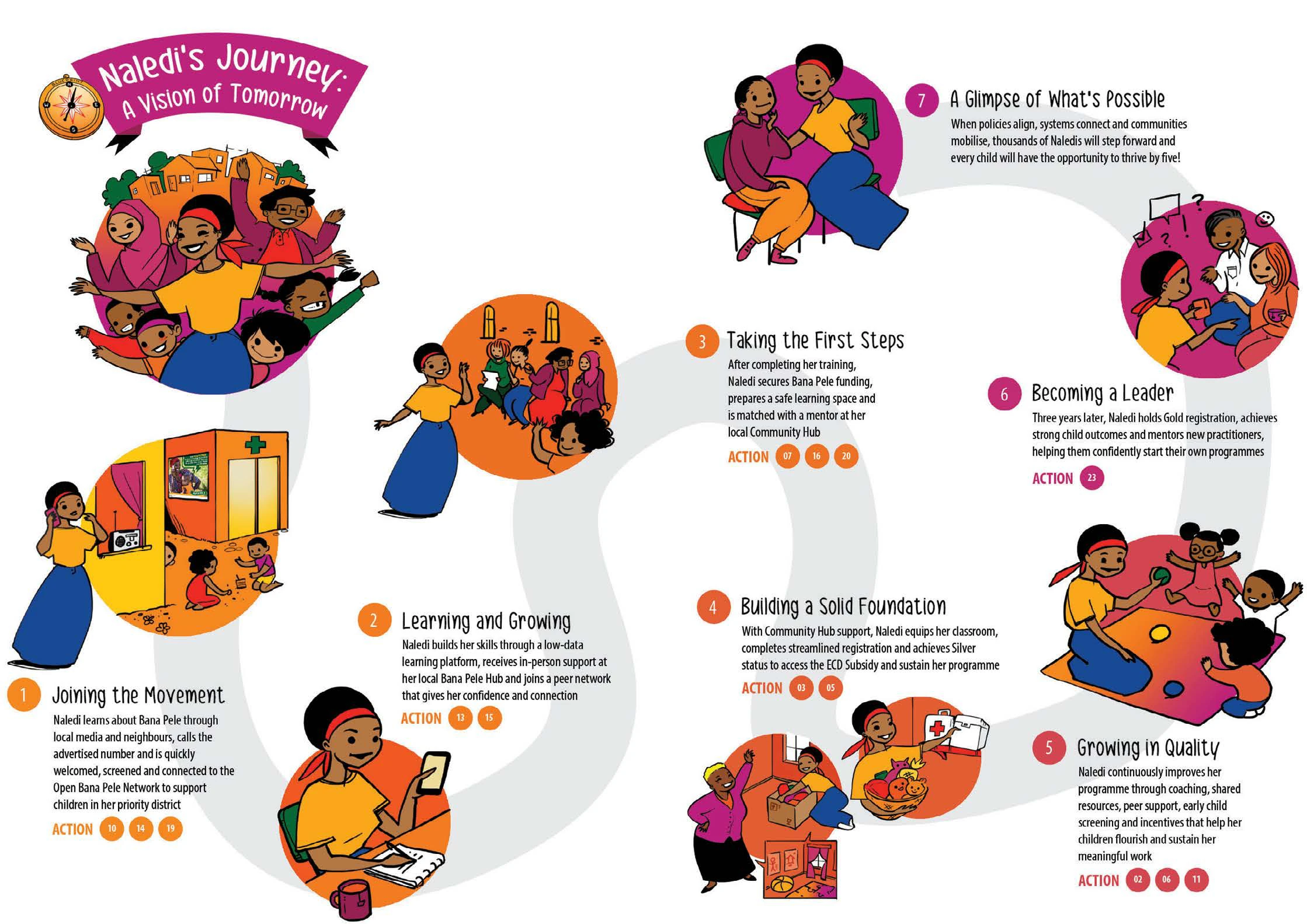

Naledi’s Journey: A Vision of Tomorrow
The action agenda set out above is the start of the journey to scale. This is not intended to read as a list of things to do but rather as a framing that triggers ecosystem action. To bring the five stages of delivery to life, here is an example of one of many potential stories that can emerge from this. Imagine Naledi, a young woman in a rural community who has always dreamed of helping the children in her area. This is her story, not as it is today, but as it could be when the Blueprint’s actions work together as a connected, supportive system.
JOINING THE MOVEMENT
Naledi first hears about Bana Pele through community radio, posters in her local clinic and conversations with neighbours who speak of a new national commitment to putting children first. The shared narrative resonates with her and feels like an invitation to contribute to something bigger than herself (Action 10: Commission creative agencies to share and reinforce the narrative).
One afternoon, she calls the Bana Pele number she’s seen advertised (Action 14: Establish the Bana Pele Engagement Platform to enable sustained, two-way communication between ELPs and the DBE). She is welcomed by a friendly voice who guides her through some simple questions. They ask her a few questions about where she lives, why she wants to work with children and her experience. The system recognises that her village is in a priority district where children have limited early learning opportunities. It completes a child protection clearance and immediately connects her to the Open Bana Pele Network to kick start her journey. (Action 19: Launch the Open Bana Pele Network to build a new pipeline of ELP providers).
“You’re exactly who we’ve been looking for,” they tell her. “Let’s help you get started.”
LEARNING AND GROWING
Naledi connects to a curated learning platform where she can begin building her skills at her own pace. She’s able to watch short videos on her phone, even when data is limited, about how young children learn through play, what makes a nurturing environment and how to support children’s development (Action 13: Launch an ECD National Digital Backbone for ELP providers to connect with peers, mentors and other relevant health and social support services). When she needs in-person support, she visits her local Bana Pele Community Hub where she finds experienced ELP practitioners at her local church or community centre (Action 15: Catalyse local Bana Pele Community Hubs).
TAKING THE FIRST STEPS
After completing her initial training modules, Naledi is ready to start her own early learning programme. But she needs start-up capital. Through the platform, she applies for support from the ECCE Livelihoods Fund (Action 7: Mobilise the ECCE Livelihoods Fund to support new ELPs). The application asks: Have you found a safe space? Have you recruited children from families who need your programme?
Naledi has identified a safe space that could work and several parents in her community have already expressed interest. She gets help to repurpose her space to deliver good quality early learning (Action 20: Mobilise partners to repurpose underused public or community buildings). Her application is approved and she receives start-up capital to make the space safe and welcoming. She also connects with her local Community Hub, where experienced practitioners offer guidance and encouragement. One of them, Ma Mkhize, becomes her mentor. She’s also invited to join a peer-to-peer network of aspiring practitioners in nearby communities. They meet online and occasionally in person, sharing their hopes, their questions and their progress. Naledi no longer feels alone, there are many others like her stepping forward with hope and courage (Action 16: Launch peer-to-peer club networks for ELPs).
BUILDING A SOLID FOUNDATION
With support from the Community Hub, which includes experienced ELP partners, Naledi transforms her room into a bright, child-friendly space. She receives a health and safety starter pack with essential items like a first aid kit, cleaning supplies, age-appropriate toys and early learning materials aligned with the national curriculum framework.
Now she’s ready to register with the DBE. Through the Bana Pele engagement platform, she applies for Bronze registration through the eCares platform. District officials from the Provincial Education Department and local government visit her programme (Action 3: Deepen collaboration between PEDs and local government through the Bana Pele ECHO Hub). They’re encouraging and helpful, guiding her through what she needs to progress toward Silver registration so she can access the ECD Subsidy (Action 5: Explore innovations that enable the ECD Subsidy to work more strategically).
With help from the local social worker and the Bana Pele desk at her municipality, Naledi navigates the Environmental Health certification process, which has been streamlined through the Red Tape Reduction Toolkit. Within months, not years, she achieves Silver registration. Her programme is official and she starts receiving the ECD Subsidy, providing the financial foundation she needs to sustain her work.
GROWING IN QUALITY
Naledi’s programme is running, but she knows there’s always more to learn. Through the digital platform, she accesses the knowledge-sharing library (Action 11: Launch national knowledge-sharing initiative), selecting resources that match her children’s needs and her community’s context. She also enters the Quality Assurance and Support System (QASS), which offers her coaching, not criticism. Her coach helps her see where she’s excelling and where she can grow.
The local Community Hub continues to be a lifeline. In her peer-to-peer club, Naledi and other practitioners celebrate wins, troubleshoot challenges and share creative ideas. When health officials from the local clinic visit to conduct immunisations and developmental screenings, Naledi uses a simple tool to identify children who may be falling behind. She knows exactly who to contact for additional support and those children receive the help they need early (Action 2: Strengthen existing systems and policies to improve access for children with additional support needs, including those with disabilities).
Financial and training incentives (Action 6: Establish the co-financed Bana Pele Accelerator Fund), encourage Naledi to keep improving. Her children are thriving, parents are grateful and she feels the pride of meaningful work.

BECOMING A LEADER
Three years later, Naledi’s programme is flourishing. She now has Gold registration and consistently achieves strong child development outcomes. But her impact doesn’t stop at her own door. She has become a mentor herself, welcoming new practitioners into her peer network, sharing lessons from her journey and helping others navigate the system that once felt overwhelming to her. She is actively contributing by providing feedback and data that strengthens the network. The network is listening and learning (Action 23: Establish a National Data Observatory to bring together insights from diverse sources).
When a young woman from the next village reaches out with a dream of starting her own programme, it’s Naledi’s turn to tell her with warmth and conviction: “You’re exactly who we’ve been looking for. Let’s help you get started. Welcome to the Bana Pele Movement”.
A GLIMPSE OF WHAT’S POSSIBLE
Naledi’s story is not real, yet. But neither is mere fantasy. There are examples of Naledi’s out there. This story illustrates how actions in this Shared Blueprint can catalyse more talent like Naledi by opening multiple pathways, incentivising and supporting increased quality and accelerating new access. When policies align, systems connect, funding flows and communities mobilise, the path from dream to impact becomes clear. And when thousands of Naledis step forward, supported by an ecosystem that believes in them, every child will have the opportunity to thrive by five.